
ISSB & CSRD: What Global Companies Need to Know
Understand how ISSB and CSRD are shaping global sustainability reporting and what they mean for your business.

Published:
The best-case scenario for companies is the idea that various modes of sustainability reporting and regulations will eventually converge: a single global baseline, fewer frameworks, and less duplication for companies that operate across regions.
But as the EU weighs a potential move to integrate ISSB standards, the reality is more nuanced. As convergence gains momentum, companies are undergoing a transition period where multiple frameworks still coexist.
The Promise of Convergence
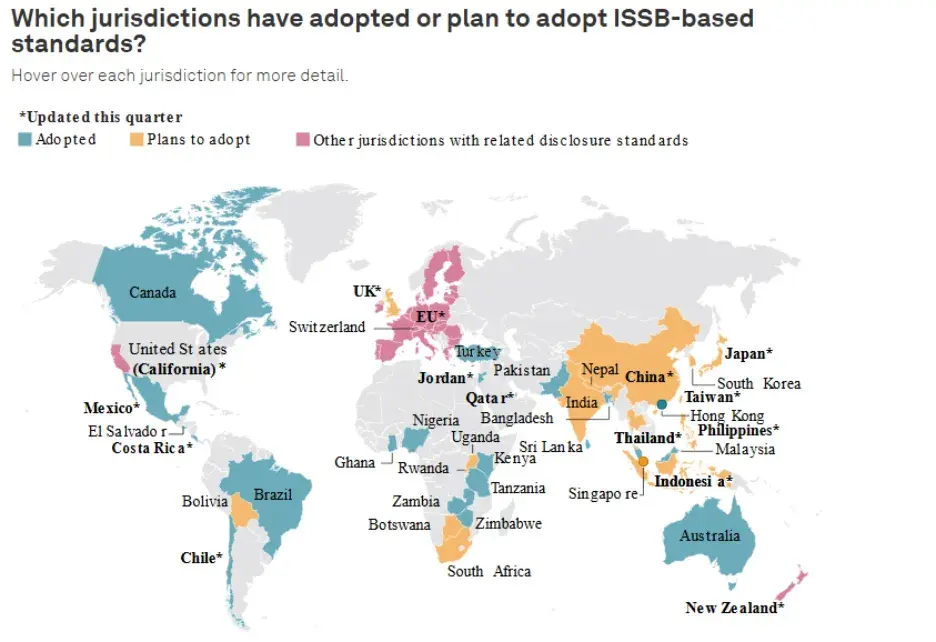
When the International Sustainability Standards Board launched its standards, the vision was to create a global, investor-focused baseline for sustainability disclosures. The expectation was that ISSB would serve as the global foundation, and regional frameworks would align over time. Ideally, companies could report once and reuse their data across jurisdictions, greatly simplifying sustainability reporting.
What’s Actually Happening Now
We are seeing a mix of convergence and divergence. Many jurisdictions are moving toward ISSB as a financial disclosure baseline, signaling growing global alignment. At the same time, the EU continues to operate under CSRD and ESRS, which take a fundamentally different approach.
Driven by concerns about reporting complexity and pressure for global comparability, the EU is now exploring how to better align with ISSB.
The Core Tension: Double vs Financial Materiality
At the center of this discussion is a structural difference:
ISSB focuses on financial materiality. This “outside-in” perspective looks at how sustainability issues affect enterprise value and financial performance.
CSRD, through ESRS, is built on double materiality. This combines: financial materiality (risk to the company) and impact materiality (impact on the environment and society). Crucially, ESRS is designed to consider these together, not separately.
This core difference shapes how data is collected, structured, and reported.
A Likely Outcome: Separate but Parallel Reporting
The direction now being discussed is a structural compromise: rather than full alignment, the EU may move towards separating these concepts in reporting:
Financial disclosures aligned with ISSB
Impact disclosures retained within ESRS
On paper, this improves interoperability and supports alignment with a global baseline. In practice, it creates two parallel reporting streams that companies must manage during the transition period.
What This Means for Companies
While the long-term direction points toward greater alignment, the immediate reality for companies is managing multiple frameworks simultaneously.
1. One dataset, multiple outputs
Organizations will need to report across all frameworks, using the same underlying data to support:
ISSB-aligned financial disclosures
ESRS-aligned impact disclosures
Potentially additional regional requirements
2. Data architecture becomes critical
Companies will need to distinguish between financial risk data and impact data while still maintaining consistency between the two, increasing data modelling sophistication.
3. Reporting becomes a systems problem
The challenge is no longer just gathering the data and producing a report. Companies must structure data so it can be reused, map data across frameworks, and maintain traceability and auditability.
What to Look for in a Carbon Accounting Platform
In this environment, platform capabilities matter more than ever. Companies should prioritize solutions that support:
Multi-framework reporting across ISSB, ESRS, and regional requirements
Flexible data models
Clear data mapping between financial and impact disclosures
Audit-ready traceability across all reported metrics
The goal is not just to complete reporting, but to build a scalable system that can continue to adapt as standards evolve.
From Complexity to Convergence
The question is no longer just whether the EU will adopt ISSB, but how companies will operate during a period of partial alignment and ongoing transition towards convergence.
The organizations that succeed will embrace this relative complexity through supportive carbon accounting partners and adaptable data infrastructure.
About the author

Will Turrett
COO
Will Turrett is the COO of Green Project Technologies, an AI climate management platform helping businesses of all sizes measure, manage, and reduce emissions across complex global value chains.