
Turn service spend into a number you can act on
Spend-based estimates treat every dollar the same. Our SCF calculator uses service-specific reference units to compare suppliers on real emissions.
Trusted by 700+ enterprise clients


How the SCF calculator works
1Request & calculate
Request SCFs for the services provided. Suppliers calculate footprints in a guided interface that assigns each service its category reference unit (e.g., person-day for consulting or vCPU-hour for cloud), tagged with quality tier and delivery mode, not spend.
2Automate quality checks
Validation flags missing activity data and mismatched allocation bases before anything is shared. Allocation matters: the wrong basis for a shared cost can flip a footprint from 140 tCO2e to 70 tCO2e.
3Receive consistent, comparable outputs
Every SCF follows the same allocation and normalization method, so a person-day from one supplier means the same thing as a person-day from another.
4Send data straight to your dashboard
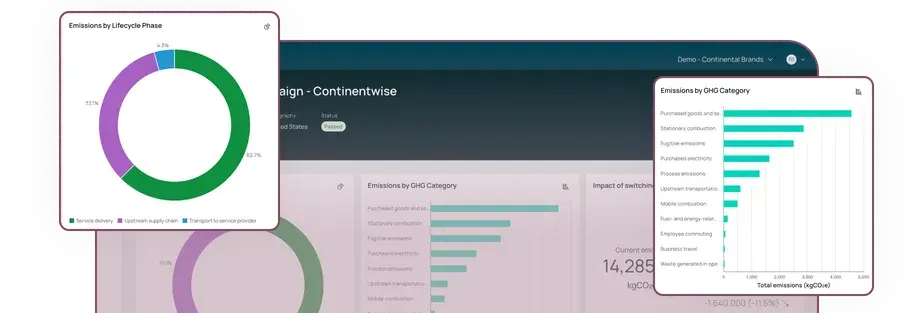
SCFs flow directly into your dashboard, replacing spend-based line items with service-specific data ready for Scope 3 reporting and supplier comparison.
What this means for your Scope 3 program
Accurate reference units
End-to-end auditability
Reporting decoupled from spend
Turn data into Scope 3 action
From service to footprint, in minutes
Describe the service and the calculator does the rest: splitting direct emissions from shared overheads, applying the correct allocation method, and normalizing the result to your category's reference unit. No spreadsheets or manual allocation needed.
There are two ways to get there: top-down disaggregates your existing corporate inventory for a fast first estimate; bottom-up builds from operational activity data for an auditable, low-uncertainty number. Most companies start top-down and move to bottom-up as the target state.
SCFS: A Methodology Guide
Spend-based estimates track your budget, not your emissions. Green Project's whitepaper sets out a practical methodology for calculating, reporting, and using Service Carbon Footprints (SCFs): verified, per-unit emissions figures for the services in your supply chain.
Explore Service Carbon Footprints

A Beginner's Guide to Service Carbon Footprints
Learn how Service Carbon Footprints measure emissions from services, improve Scope 3 data accuracy, and support more effective supplier engagement.
Service Carbon Footprints: From Reporting to Supplier Action
See how Service Carbon Footprints help procurement teams measure supplier emissions and drive reductions.

Fixing the Services Emissions Blind Spot
Learn how Service Carbon Footprints can close Scope 3 data gaps and drive supplier decarbonization.
How to Calculate a Service Carbon Footprint (SCF)
Learn how to calculate a Service Carbon Footprint and measure emissions associated with purchased services.
Start collecting service-level data at scale
Replace spend-based Scope 3 estimates with SCFs normalized to real reference units - person-day, vCPU-hour, room-night, tonne-kilometre, m² serviced-year.
Frequently Asked Questions
Have more questions?
What is a Service Carbon Footprint (SCF)?
An SCF is the greenhouse gas footprint of a single service, normalized to a reference unit for that category, a person-day of consulting, a room-night of accommodation, a vCPU-hour of cloud compute, so it can be compared and reduced like any other cost driver.
Who is an SCF designed for?
Buyers and suppliers who need Scope 3 data beyond spend-based estimates. Data maturity progresses from industry-average (spend-based) to supplier-specific to service-specific — SCF is the service-specific, spend-decoupled endpoint.
Why is SCF important for services companies?
Spend is a poor proxy for emissions in services. Two engagements costing the same dollar amount can have very different footprints depending on travel, delivery mode, and energy source - SCF measures the activity that drives emissions, not the invoice.
What are the main use cases for the SCF calculator?
Three SCF levels:
Level 1 Indicative (top-down, refresh annually)
Level 2 Robust (service-level allocation, valid up to 3 years)
Level 3 SCF+ (use-case aligned: comparison, commercial claims, certification).
Recalculate at any level when a material change shifts the SCF by 10%+.
What role does AI play in the SCF calculator?
AI helps users select the most appropriate functional and allocation units when calculating an SCF.
What standards and frameworks does the SCF calculator align with?
Three standards define the starting point: PACT v3.0 declares reference units by service type (e.g., hours for desk-based services, megabyte-seconds for IT) and positions itself as a baseline; ISO 14067 establishes the basis for a footprint but doesn't resolve units or allocation; GHG Protocol Product covers services in principle, but its worked examples were built for physical goods. Our SCF methodology fills the gap those three leave open.