
Get a product carbon footprint for everything you buy
Our AI-powered PCF calculator guides every supplier, regardless of carbon expertise, to a standards-aligned PCF in minutes.
Trusted by 700+ enterprise clients


How the PCF calculator works
1Request and calculate
Request PCFs for the products you procure. Using our AI-enabled, guided interface, suppliers calculate audit-ready Cradle-to-Gate PCFs compliant with GHG Protocol, ISO 14067, PACT, and TfS standards.
2Automate quality checks
Automated validation flags gaps and inconsistencies so suppliers can fix issues before anything is shared.
3Receive standardized results
We use one methodology across every submission so PCFs are comparable across suppliers and product lines, not just internally consistent.
4Send data straight to your dashboard
Verified PCFs flow directly to you. No manual exchange, no spreadsheets, full visibility the moment your data is ready. Export via API to connect the data to whatever system you already use.
Turn product-level data into better decisions
The PCF calculator replaces spend-based guesswork with product-specific emissions data.
Target the right products
Request exactly what you buy
Trust every number you receive
Pull directly into Scope 3 action
See where your emissions actually come from
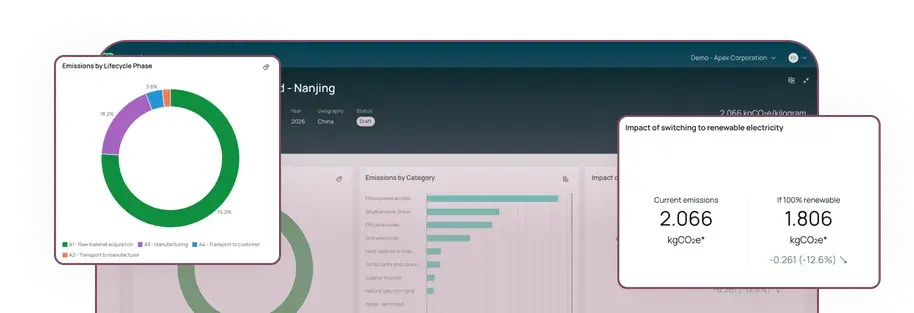
Our PCF Insights break your footprint down by lifecycle phase and category, with an interactive view showing exactly where emissions originate.
PCF Insights also models a 100% renewable energy scenario against your current footprint so you can see the impact and the cost before committing.
From there, you can connect suppliers directly to renewable energy procurement through Green Project's marketplace.
Practical Guide
Decoding Product Carbon Footprints: Methodologies and Benefits
A practical breakdown of PCF methodologies (ISO 14067, PACT, sector specific standards), system boundaries, and data collection, so you can choose the right approach for your product and market.
"Think of a PCF as a nutrition label for a product—with only one nutrient: GHG emissions."
Explore Product Carbon Footprints

What is a PCF?
Discover what a Product Carbon Footprint (PCF) is, how it’s calculated, and why it’s becoming essential.
How to Calculate a Product Carbon Footprint (PCF)
Learn how to calculate a Product Carbon Footprint and measure emissions across a product’s life cycle.


Engaging Your Supply Chain to Reduce Scope 3 Emissions
Learn how to engage suppliers, improve emissions data, and drive measurable Scope 3 reductions across your supply chain.
Start collecting product-level data at scale
From your first request to your full supplier base, standards aligned PCFs, verified and ready for Scope 3.
Frequently Asked Questions
Have more questions?
What is a Product Carbon Footprint (PCF)?
A PCF measures the greenhouse gas emissions associated with a specific product across its lifecycle, from raw materials and manufacturing through to delivery. Unlike a corporate carbon footprint, which covers an entire organization, a PCF gives emissions data at the individual product level.
What is the PCF calculator and who is it designed for?
Green Project's PCF Calculator is an AI-powered tool that generates product-level carbon footprints in under 5 minutes. Enterprises use it to collect verified PCFs from their suppliers, replacing industry averages with product-specific data for more accurate Scope 3 measurement. Suppliers use it to calculate and share their product emissions with buyers, with visibility into where those emissions originate so they can take action to reduce them.
What are the main use cases for the PCF calculator?
Collecting verified product carbon footprints from suppliers at scale
Replacing industry-average emissions factors with product-specific data for more accurate Scope 3 reporting
Enabling suppliers at any maturity level to build PCF measurement capabilities, many for the first time
Giving suppliers a simple, guided way to calculate and share credible PCFs with their buyers
How does Green Project help me act on product data?
Verified PCF data flows straight into your Scope 3 reporting, so you can see emissions by product and product line instead of relying on spend-based estimates. From there, Green Project's Decarbonization Intelligence gives suppliers tailored recommendations and access to a library of vetted reduction initiatives they can act on directly, and Renewable Energy Procurement gives them a route to cut emissions through EACs. You get visibility into hotspots and progress; your suppliers get a clear path to actually reduce them.
What standards and frameworks does the PCF calculator align with?
The PCF calculator is aligned with the GHG Protocol Product Standard, ISO 14067, the PACT (Partnership for Carbon Transparency) framework, and Together for Sustainability (TfS) guidelines. This ensures that every product carbon footprint produced is standardized, quality-checked, and recognized across industries and regulatory frameworks.
How does the PCF calculator validate supplier data?
The PCF calculator includes automated quality assurance built into the calculation process. Validation checks identify data gaps, inconsistencies, and outliers in supplier submissions before results are shared with buyers.
This helps suppliers improve their data quality and gives enterprises confidence that the PCFs they receive are credible and audit-ready.
What role does AI play in the PCF calculator?
AI guides suppliers through the calculation itself. Once a supplier uploads their bill of materials, the calculator uses AI-assisted inputs to walk them through the rest of the process, matching data against emissions factors aligned with GHG Protocol, ISO 14067 and PACT. AI is also behind the automated quality checks: flagging data gaps and inconsistencies before a PCF is ever shared, so suppliers can fix issues themselves rather than having errors surface later in the process.
In short, AI removes the guesswork from calculation and catches problems early, while the methodology and standards behind the numbers stay fixed and auditable.