


For the past several years, carbon accounting has been defined by measurement. Companies raced to understand their emissions footprint, stood up reporting frameworks, and invested heavily in data infrastructure. Getting the numbers right was the goal, and for a long time, that was enough.
In 2026, Scope 3 expectations have matured. Regulatory frameworks like CSRD and CSDDD are moving from guidance to obligation, and investors are increasingly scrutinizing not just what companies are disclosing, but what they are doing about it.
Which means the question driving sustainability programs has shifted, too. It is no longer "what are our emissions?" but “what are we going to do with this information?”
Measurement was always a means to an end. The organizations pulling ahead in 2026 are the ones treating it that way and using their data not just to report, but act.
In this guide, we’ll explore why making that move from measurement to reduction is one of the most strategically valuable decisions a procurement or sustainability leader can make in 2026 and beyond.
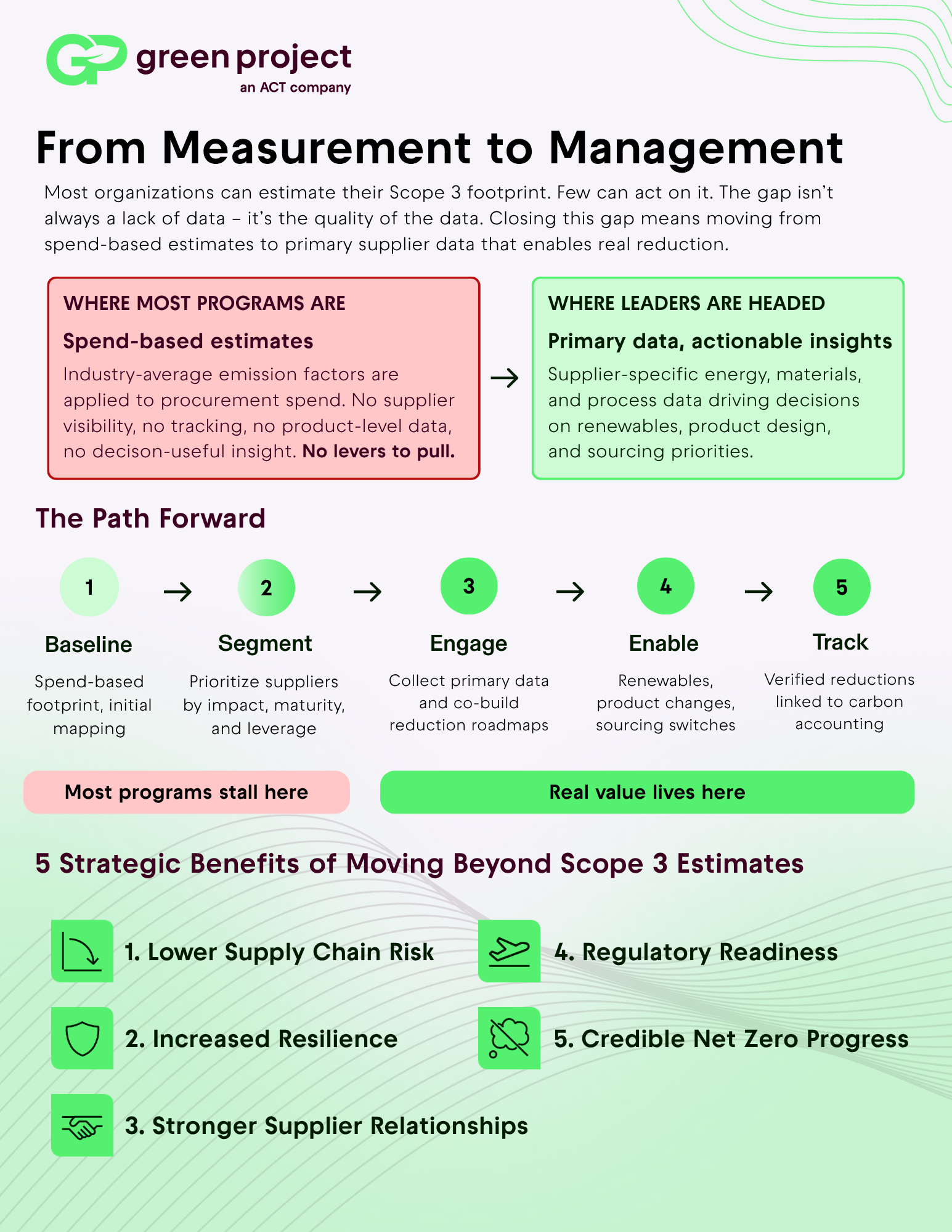
As emissions data matures, forward-thinking organizations are discovering that the real value isn't in the measurement itself, but in what you do with it.
Your emissions data is, at its core, a risk map. When procurement teams move beyond collecting supplier data to actively acting on it, the risk profile of their entire supply chain improves.
Supplier relationships are de-risked because emissions performance is increasingly a proxy for operational maturity; suppliers who have begun reducing tend to run more efficiently, face fewer regulatory penalties, and are less likely to become a liability as climate disclosure requirements tighten.
Buyer mandates and Science Based Targets are already filtering preferred vendor lists at major corporations; suppliers that have started the reduction journey now are building the track record that will determine whether they're a preferred partner or a replaced one in three years.
Procurement leverage strengthens as a result. Sustainability performance stops being a checkbox and becomes a negotiating lever that influences pricing, contract terms, and long-term partnership decisions.
And the analytical discipline built through active reduction programs, such as benchmarking suppliers, identifying emissions outliers, tracking progress over time, translates directly into sharper internal risk management, giving procurement teams earlier warning signals and better tools to act on them before disruption hits.
Organizations that move from measuring emissions to actively reducing them find that decarbonization and operational durability are tightly linked.
Energy procurement optimization is one of the clearest examples. Shifting away from fossil-based energy sources reduces exposure to the price volatility that has repeatedly disrupted supply chains over the past decade, meaning more predictable costs, more stable supplier economics, and fewer emergency sourcing decisions made under pressure.
Suppliers that integrate sustainability into their operations tend to run leaner as a result: fewer inefficiencies, lower waste, and better margins, which makes them more reliable partners over the long term.
Reducing exposure to carbon pricing mechanisms matters for the same reason: as carbon costs expand across key markets, suppliers that have already acted are insulated from the cost shocks that will squeeze those who haven't, protecting your supply chain from upstream margin pressure being passed downstream to you.
The forecasting benefits compound over time. Organizations that move beyond data collection into active reduction programs develop sharper, more granular visibility into their supply chains, enabling more accurate scenario planning, faster identification of vulnerabilities, and better-informed sourcing decisions before disruption forces the issue.
Finally, governance maturity adds another layer of stability: suppliers with robust sustainability systems have fewer ethical breaches and fewer regulatory penalties, making them lower-maintenance and more resilient partners through periods of market stress.
There's a meaningful difference between a supplier who reports because they have to and one who acts because they see the value. Moving from measurement to reduction is what shifts that dynamic, and the quality of supplier relationships shifts with it.
Reduction programs reframe the buyer-supplier conversation from compliance to collaboration. Rather than showing up once a year to request emissions data, procurement teams that are actively working toward shared reduction goals create ongoing touchpoints with real substance: joint target-setting, shared progress tracking, and mutual accountability.
That shift reduces reporting fatigue on both sides as suppliers stop feeling audited and start feeling supported, which directly improves retention. Buyers who make it easier for suppliers to act, rather than just disclose, become preferred customers, and the long-term transparency that follows makes supplier relationships more durable and easier to manage.
Shared incentives are the engine underneath all of this. When suppliers have access to tools that make reduction achievable, like renewable energy procurement through platforms like act50, or free emissions tracking resources, decarbonization stops being a burden placed on them and becomes something they have a stake in.
That changes the nature of the relationship fundamentally and creates the kind of supply chain partnerships that hold up under pressure.
The regulatory landscape around corporate emissions is no longer a distant consideration, but a defined timeline. The organizations that treat reduction as a strategic priority now will be the ones best positioned when regulations come into effect.
Scope 3 requirements are the clearest example. CSRD and CSDDD frameworks are progressively raising the bar on what companies must disclose about their supply chain emissions, and disclosure without demonstrated action is increasingly insufficient.
Organizations that have moved into active reduction programs aren't just collecting the data these frameworks require; they're building the supplier-level evidence trails, audit-ready documentation, and verifiable progress records that turn compliance from a scramble into a formality.
SBTi alignment adds another dimension. Setting and contributing to Science Based Targets requires more than measurement. It requires demonstrable, quantified reduction trajectories at the supplier level. Organizations that have already begun that work are ahead of a requirement that more buyers and regulators will soon mandate.
And as renewable energy requirements tighten across key markets, suppliers and buyers alike who have already begun the transition will face lower costs, less disruption, and stronger negotiating positions than those making the shift under pressure.
Investors, customers, and regulators have grown skeptical of corporate climate pledges that aren't backed by operational evidence, and the gap between what companies say and what they can demonstrate is increasingly where reputational and financial risk lives.
Emissions data becomes meaningful when it's converted into quantifiable reduction trajectories; not just a snapshot of where you are, but a verified record of where you're going and how fast.
Supplier-level decarbonization is particularly powerful here: it moves the narrative from corporate commitments, which are easy to make, to operational follow-through across the supply chain, which is hard to fake.
That distinction matters enormously to investors, who are paying closer attention to whether sustainability claims are backed by supply chain reality.
Organizations that can demonstrate it are strengthening their capital access narratives: lower perceived risk, stronger ESG scores, and better positioning in conversations with lenders and institutional investors who are tightening their own climate criteria.
Brand integrity compounds these gains over time. As scrutiny of greenwashing intensifies, the organizations that will hold their reputations are the ones who can point to supplier-level data, verified reductions, and tools like act50 that show they didn't just measure the problem, they did something about it.
The strategic sequence from measurement to action is clear: measure, analyze, prioritize, execute.
Most organizations have made real progress on the first step. The value gap is in the three that follow: turning data into decisions, decisions into targeted action, and action into verified, scalable reduction.
This path requires more than good intentions. It requires access to quality data and the tools to act on it, platforms that can engage suppliers, enable renewable energy procurement, and convert emissions visibility into measurable progress.
Green Project offers solutions for each step in that sequence, built for organizations that are ready to move from knowing their footprint to shrinking it.
Reduction, and reduction at scale, is the defining challenge of this decade. The question is no longer whether to act. It's whether you have the infrastructure to do it credibly, efficiently, and at the speed the moment requires.
