Most emissions sit in Scope 3, but procurement teams lack the data, tools, and governance to act.
Supplier engagement is often survey-heavy and impact-light, leaving category managers firefighting instead of redesigning value chains.
This roadmap offers a practical sequence of steps over 1-3 years: build spend-based visibility, move to hybrid and supplier-specific data, embed decarbonization into sourcing and contracts, and finally, scale and innovate.
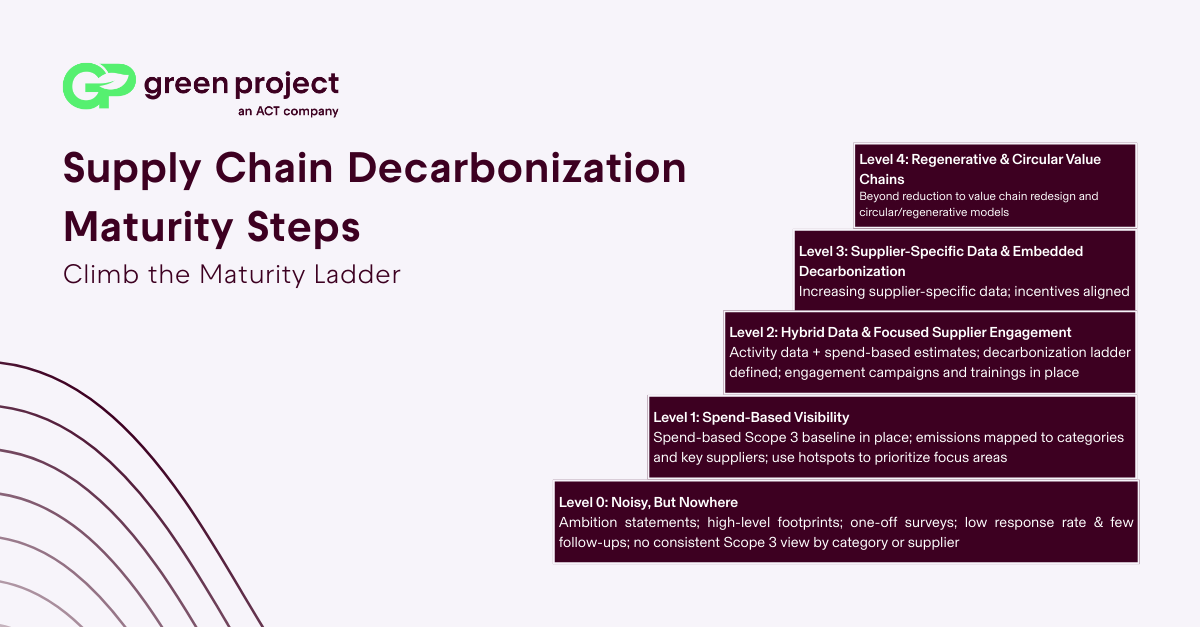
The maturity ladder and timeline illustrate how organizations can progress from ambition statements to circular value chains.
Most emissions sit in an organization’s value chain. This 1-3 year roadmap shows procurement and sustainability teams how to move from spend-based estimates and one-off surveys to targeted supplier programs, better data, and decarbonization embedded in category strategies.
Why supply chain decarbonization stalls in practice
Before talking solutions, it helps to name the real constraints procurement teams face.
Scope 3 is huge, but blurry: Most organizations know that 70-90% of their emissions sit with suppliers and customers. But the view is often annual, high‑level, and static. Emissions aren’t mapped clearly to categories, contracts, or suppliers, and category teams don’t know where to focus.
Data lives in the wrong places: The activity and financial data needed to act sits in finance systems, logistics providers, and suppliers. Sustainability teams may build models, but procurement rarely sees them in their sourcing and SRM processes.
Supplier engagement is designed for auditors, not change: Typical ESG questionnaires are long, have low response rates, and provide little feedback or support. Suppliers see this as compliance admin, not a decarbonization partnership.
Category managers are overwhelmed: They are expected to deliver savings, manage risk and growth, and decarbonize, without capacity or tools. Sustainability becomes a reporting add‑on rather than a lever for better specifications and supplier relationships.
The business case is fuzzy: Leadership wants to know where decarbonization will protect margins, reduce costs, or improve resilience. The links exist – around energy, logistics, materials, and risk – but they’re rarely quantified in a way that procurement and finance can own.
A simple maturity ladder for supply chain decarbonization
Think of supply chain decarbonization as climbing a maturity ladder. Most organizations move through these levels over 1-3 years in their priority categories.
Level 0 – Noisy, but nowhere: Ambition statements and perhaps a high‑level footprint, but no consistent Scope 3 view by category or supplier. One‑off supplier surveys yield little insight.
Level 1 – Spend‑based visibility (Year 1): A spend‑based Scope 3 baseline is in place. Emissions are mapped to categories and key suppliers at a basic level. The CPO and CFO can see the hotspots and use them to prioritize 3-5 focus categories.
Level 2 – Hybrid data & focused supplier engagement (Years 1–2): Activity data is layered on top of spend, and a supplier decarbonization ladder is defined. Supplier campaigns, training, and templates are in place.
Level 3 – Supplier‑specific data & embedded decarbonization (Years 2–3): Increasingly, the organization uses supplier‑specific data such as corporate footprints and PCFs. Decarbonization criteria are embedded in category strategies, sourcing events, contracts, and SRM. Incentives are aligned.
Level 4 – Regenerative & circular value chains (3+ years): Beyond reduction, the focus shifts to circular and regenerative models. Procurement, sustainability, finance, and operations collaborate to redesign entire value chains.
The 1-3 year roadmap – step by step
The four-level roadmap journey can be framed as three overlapping phases. Each phase may take months or years, and organizations often work on several steps in parallel.
Phase 1 – Build foundations and focus (Months 0–12)
Align ambition and assign joint ownership across procurement, sustainability, finance, and operations.
Build a spend‑based baseline linked to categories and suppliers using finance and procurement data.
Select 3-5 priority categories and set 1-3 year goals for data quality and emissions reduction.
Define a supplier decarbonization ladder tailored to each priority category.
Phase 2 – Engage suppliers and upgrade data (Months 6–24)
Run structured supplier campaigns with clear asks and support, tailored to strategic and SMB suppliers.
Move to hybrid data in key categories by combining activity‑based data with spend‑based estimates.
Embed decarbonization into sourcing and contracts with climate criteria, carbon‑adjusted TCO, and reduction clauses.
Phase 3 – Scale, incentivize and innovate (Months 18–36)
Scale the supplier ladder and playbooks across more categories, making them standard operating practice.
Align incentives for procurement teams and suppliers so decarbonization performance influences procurement KPIs and supplier status.
Digitize and automate data and workflows, and gradually layer AI for spend categorization, data quality, and contract analysis.
Close the loop by reporting progress by category, capturing lessons learned, and resetting goals.
How this roadmap reflects emerging leading practice
The patterns described here reflect insights from collaborative Scope 3 initiatives and sustainable procurement research.
Across sectors and regions, organizations that make real progress on supply chain decarbonization treat Scope 3 as a procurement and value‑chain program; sequence their journey over manageable 1-3 year horizons per category; and invest in simple, repeatable tools – ladders, playbooks, templates and digital support – so that decarbonization becomes part of category management.
Where to start this quarter
For a procurement team asking where to start, a realistic 90‑day plan might include:
Build a rough spend‑based emissions heatmap by category and supplier.
Choose 3-5 priority categories based on emissions, risk, and strategic relevance.
Draft a first version of the supplier ladder for those categories.
Plan one structured supplier campaign in a single category as a pilot.
Document what you learn and refine the approach before scaling.
Market note: choosing platforms that go beyond reporting
Over the last few years, the market for ESG reporting and carbon accounting software has exploded.
Many platforms focus primarily on collecting data, producing dashboards, and generating disclosure‑ready reports for frameworks such as CSRD, ISSB, or investor questionnaires.
A smaller subset of platforms are explicitly designed to help buyers mobilize suppliers and execute decarbonization pathways, rather than just measure emissions.
Green Project's suite50 unifies audit-grade carbon accounting, supplier engagement, and global renewable energy procurement, delivering end-to-end decarbonziation solutions. act50, the renewable energy marketplace within suite50, enables buyers to link supplier‑level clean‑energy purchases directly to Scope 3 performance.
When procurement teams assess technology options, it is worth asking not only how well a platform helps you report, but also how well it helps your suppliers choose, finance, and execute real decarbonization.