


The procurement community has spent five years getting good at counting carbon. Baselines have been built. Spend-based estimates refined. Supplier surveys launched, chased, and, in the best cases, returned.
Yet for most organizations, the distance between their Scope 3 inventory and an actual ton of CO₂e avoided remains vast.
Proxima’s benchmarking suggests many organizations are still early in integrating Scope 3 into procurement, and the Scope 3 Peer Group continues to highlight supplier engagement as a recurring top challenge as the market shifts from measurement to supplier action at scale.
Counting matters, but it has become a comfort zone: progress without the harder conversations about capital investment, technology switching, and supplier capability that actual decarbonization demands.
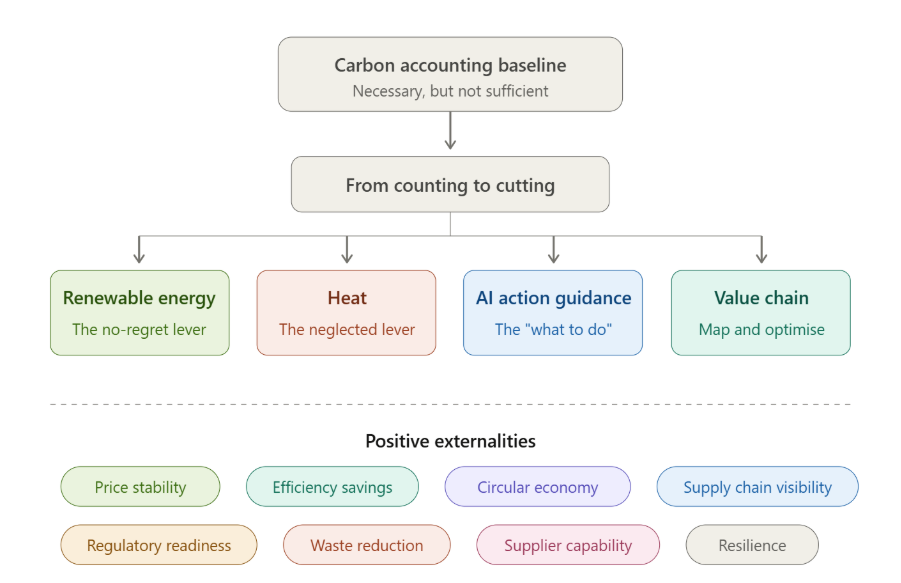
The shift now underway is from carbon accounting to carbon action. And it is not a trade-off: the companies making the fastest progress are also discovering tangible business value: resilience, efficiency gains, cost savings, circular economy opportunities, and stronger supplier relationships.
This piece maps four practical decarbonization pathways that procurement teams can activate today.
For electricity-intensive value chains, supplier renewable electricity can be a material Scope 3 lever.
For example:
Beyond emissions, this pathway delivers resilience: suppliers gain protection against fossil fuel price volatility, and renewable contracts lock in predictable energy costs. As regulatory requirements tighten, suppliers with clean energy credentials qualify for contracts that others do not. Helping suppliers access renewables is supply chain risk management.
The scalability challenge is access. Most SME suppliers have never purchased an EAC. Green Project's act50 operates as a digital marketplace, connecting suppliers with affordable, instantly-transactable EACs across 40+ countries;no minimum volume, no complex negotiation, and no prior experience required.
Thermal energy often represents 50%+ of supply chain emissions in manufacturing, chemicals, and food sectors. Technologies exist heat pumps, electric boilers, biomethane)but most suppliers don't know which fits their process, and most buyers have never asked.
Unilever's Supplier Climate Program provides the blueprint:
Schneider Electric's 12-step Zero Carbon Project recipe from segmentation through training, SME support, and green financing)has also become a cross-industry reference model.
The overlooked gift here is efficiency: thermal assessments routinely surface 10–20% energy savings before any technology switch. The conversation shifts from "spend money on decarbonization" to "find savings while reducing emissions;" a fundamentally more motivating proposition.
When a supplier asks "what should I actually do?" the answer is too often vague. This is the gap that decarbonization action libraries and, increasingly, AI-powered recommendation engines fill.
The next evolution is AI that generates tailored recommendations for each supplier based on their emissions profile, sector, geography, and maturity, complete with estimated abatement potential and an auto-generated business case the supplier can take to their own leadership.
This is what buyers want: AI-enabled capabilities that translate data into reduction roadmaps, forecasts, and engagement recommendations. The bottleneck in supplier decarbonization is capacity at the supplier level. AI makes tailored, scalable guidance feasible for the first time.
Action libraries also unlock circularity:
Circularity is not a separate workstream, it is a decarbonization accelerant.
Most procurement teams make category decisions based on corporate-level data. They don't know where emissions concentrate across the specific product value chain they are buying.
Knowing where emissions sit is necessary but not sufficient. Pathway optimization engines use mathematical modelling with forward-looking data to build lowest-cost decarbonization pathways, modelling interdependencies that static abatement cost curves miss.
For procurement, this transforms category strategy: instead of generic "reduce by X%" targets, category managers can see the specific sequence of interventions optimized by cost, feasibility, and impact.
Enablement beats exclusion. Suppliers respond to tools, training, and incentives far more reliably than compliance demands.
Collaboration multiplies impact. Pooled demand, shared projects, standardized asks; the fastest movers are the ones willing to share.
Procurement must own the outcome. Carbon in sourcing criteria, contracts, scorecards, and objectives. For example, Unilever has trained 150 buyers, and Schneider embeds GHG into award decisions.
Decarbonization creates value, not just cost. Energy savings, price stability, resilience, competitive advantage, circularity; the best leaders ask, "how much value can we unlock while decarbonizing?"
Imperfect action beats perfect data. Every company here started before data was complete, standards finalized, or tools mature.
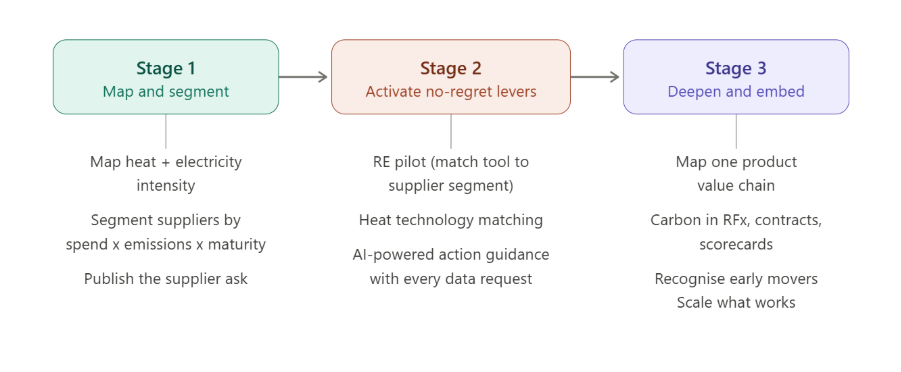
Map your supply chain by heat and electricity intensity. Publish your supplier ask: one page setting out expectations on targets, disclosure, renewable energy, and a 12-month action plan.
Launch a renewable energy pilot matched to supplier scale. Assess heat-intensive suppliers and begin technology matching. Equip suppliers with AI-powered action guidance; every data request paired with a tailored "here's what to do and here's the business case."
Map one product value chain, model the optimized pathway, and use both to inform sourcing. Embed carbon into RFx, contracts, and scorecards. Recognize early movers. Scale what works.
The era of carbon accounting as a standalone activity is over. The scarce resource is no longer the ability to calculate a footprint. It is the ability to convert that footprint into funded projects, supplier action, and verified reductions.
Renewable energy. Heat. AI-powered action guidance. Product value chain mapping and pathway optimization. These are being deployed, refined, and scaled with measurable results,generating returns far beyond the carbon ledger.
The question is no longer whether procurement should lead supply chain decarbonization. It is whether your team is equipped to deliver.
The climate doesn't care who gets the credit. It cares about reductions. So let's focus on that.
Mat Langley is a sustainable procurement advisor, supporting organizations on Scope 3 strategy, supplier engagement, and the integration of sustainability into procurement operating models. He advises Green Project Technologies and works closely with the Scope 3 Peer Group, SPP, and global procurement leaders.
